
What is E-Invoicing?
E-Invoicing in Malaysia
E-Invoicing (Electronic Invoicing) is a digital system where invoices are created, validated, and stored electronically through the Inland Revenue Board of Malaysia (LHDN) MyInvois system.
Instead of issuing traditional paper invoices or PDF invoices, businesses will submit invoice information to LHDN electronically, where it will be validated before being shared with the buyer.
The purpose of e-invoicing is to:
• Improve tax compliance
• Reduce tax evasion
• Increase transparency in business transactions
• Digitise Malaysia’s tax administration system
Malaysia’s e-invoicing initiative is part of the government’s digital transformation and tax modernisation program.
How E-Invoicing Works in Malaysia
The e-invoicing process generally involves the following steps:
Step 1 – Seller Creates Invoice
The seller generates an invoice using their accounting system, ERP system, or the MyInvois Portal.
Step 2 – Invoice Submitted to LHDN
The invoice data is submitted electronically to LHDN’s MyInvois System through:
• API integration
• MyInvois Portal
Step 3 – LHDN Validates the Invoice
LHDN validates the invoice and assigns a Unique Identification Number (UIN) and QR Code.
Step 4 – Invoice Sent to Buyer
The validated invoice is then shared with the buyer as the official e-invoice.
Types of E-Invoices in Malaysia
Malaysia’s e-invoicing system covers several types of documents.
1. Invoice
Used for business-to-business (B2B) transactions.
2. Self-Billed Invoice
Issued by the buyer on behalf of the supplier in certain situations such as:
• Commission payments
• Payments to agents or dealers
• Cross-border transactions
3. Credit Note
Issued to reduce the value of an invoice, such as when goods are returned or discounts are given.
4. Debit Note
Issued to increase the value of an invoice due to adjustments.
5. Refund Note
Issued when a refund is given to the customer.
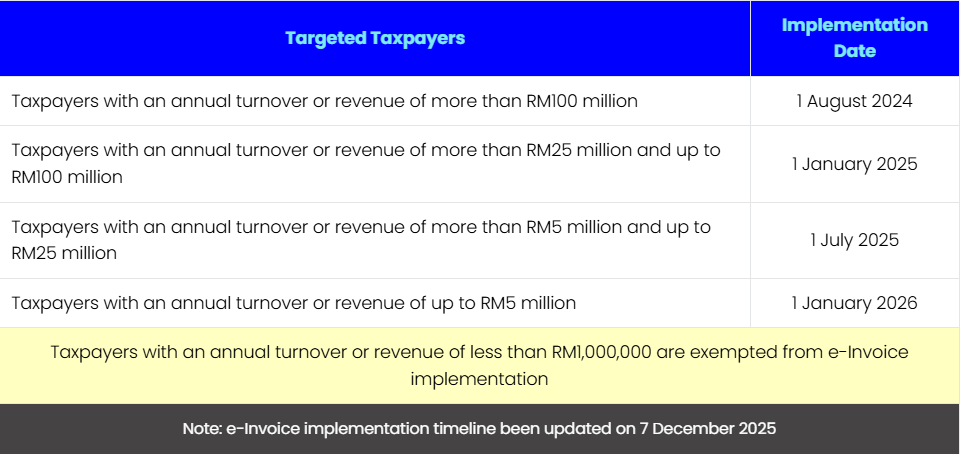
E-Invoicing Implementation Timeline in Malaysia
The Malaysian government is implementing e-invoicing in phases.
| Implementation Date | Businesses Affected |
|---|---|
| August 2024 | Businesses with annual revenue above RM100 million |
| January 2025 | Businesses with revenue above RM25 million |
| July 2025 | Businesses with revenue above RM500,000 |
| 2026 onwards | All businesses |
Businesses must prepare their accounting systems and processes before their implementation date.
How A. Razak & Co. PLT Can Help
At A. Razak & Co. PLT, we assist businesses in preparing for Malaysia’s e-invoicing implementation.
Our services include:
• E-invoicing readiness assessment
• Advisory on MyInvois system implementation
• Assistance with accounting system integration
• Staff training on e-invoicing compliance
• Ongoing tax advisory services
With our professional guidance, businesses can transition smoothly to the new e-invoicing system and remain compliant with LHDN requirements.
📞 Contact A. Razak & Co. PLT today to prepare your business for e-invoicing in Malaysia.

